Sunday, 17 August 2014

Bite Me

Four months ago, my boyfriend Tom and I moved to Vancouver, Canada. We live with his brother Joe and Joe's girlfriend Kat, and Kat's cat, Sooty. In the flat above live his parents, and in the backyard lives our growing vegetable patch.

When I moved to New Zealand I was 20, brimming with life and ready to do as many adrenaline rushing extreme sports as possible. I broke up with my ex, partied hard, lived in a hostel, moved into a flat, sky dived, went caving, pot holing, jumped off Auckland's Sky Tower, white water rafted, hiked, skinny dipped and generally did as much as I possibly could before I returned home. I made some wonderful friends and often look back at that time with great fondness and laughter; everything was 'Sweet as'.

When I returned home I spent a year wanting to get away again, and despite being in a wonderful relationship, I was angsty and ready to travel again. I hated my job and I felt trapped. So that's when Charli suggested I move to Australia to live with her, her parents and her young twin siblings. I leapt at the opportunity and before I knew it I was living in Mandurah on the West coast of Aus, south of Perth.

This was ultimately a very different experience. I wanted to enjoy my time in Australia, but I was also working full time as a waitress and living with my friends family, and I wanted to save for a big trip. Mandurah was beautiful, and whilst Charli and I had a lot of fun together, I was bored with the work and too anxious to be on the road again. Still, we booked our flights to Nepal, India and Sri Lanka and I was preparing for a short five weeks on Australia's East coast on my own, and then back to England for a few weeks before leaving to do Base Camp Everest and travel with Charli and Sophie to the one place I'd wanted to visit for a long, long time. I was desperate to go somewhere not Westernised.

During this preparation, I decided that I was going to have a Rabies and Cholera vaccination. Despite being very expensive, I was sure it would be worth it. All it would take would be one nip off a rabid dog and that would be that, so I thought I might as well be extra cautious, it wasn't like it would do any harm...

Two weeks after my third and final rabies injection I got Guillain-Barré Syndrome. Nearly two years ago now and I've read a lot to do with immunisations and GBS, with some people getting it after something as small as a flu jab. There is a lot of controversy within this subject, and my Neuro doctors were pretty sure that my immunisations were nothing to do with my GBS. But it leaves the question for future...should I ever get these vaccinations again should I need them? If I were to have kids, would I want them to have the MMR jab etc? Two weeks ago, I was faced with a choice.

I started a new job dog walking. Sounds great right? I get my own van and I basically go out and walk dogs off leash in the morning (six dogs off leash can be pretty crazy!) and private walks in the afternoon. Well, as I was training I had a couple of pretty nervous dogs who were reactive to new people, and one particularly nervous dog was called Baron.

Laura, the girl training me, went in to get Baron a few weeks ago, and by the end of the walk I was holding his leash, giving him treats out of my hand and he was letting me stroke him. When we got back to his apartment, I offered to take off his collar, but alas as I bent down to take it off, Baron freaked out and bit my face and wrist.

It was very sudden and I remember Laura just shouting at Baron and getting me through the door as I began to process what happened and started saying 'He bit me, he just bit me' and I felt the warm blood trickle down my wrist and my face starting to swell. Laura was amazing and had me in the emergency room within ten minutes as she comforted and assured me that my face was okay and it was all fine. I couldn't believe it, there I was back in hospital in another country and of course, I couldn't get hold of Tom or anyone.

After being told that the fee to even just see the doctor was $955 I felt a deep overwhelming sadness for the people of the world not lucky enough to have an NHS or health insurance with their job. What on earth could you do in that situation? Lucky for me I knew that I was covered as this was a work accident, and as Laura left at my insistence, I sat in a hospital waiting room feeling incredibly sorry for myself.

After an hour I was told to sit in a room and wait for a doctor, and as I looked around at all the hospital equipment I had my first panic attack in a long while. Overwhelmed and alone with all the old flashbacks pounding my mind, I started to practise my breathing exercises that I had learnt in therapy. I kept telling myself that I'd learnt to walk again, I could deal with a small dog bite for goodness sake. As I felt myself begin to calm down Tom showed up just in time for the doctor to start injecting the four deep puncture wounds in my wrist, numbing it so he could have a good root around to check nothing was stuck in them. This was incredibly painful but I kept just repeating 'Not as bad as a lumber puncture, not as bad as a lumbar puncture' and then my wrist was completely numb, bandaged up and a black eye began forming around my right cheek. Then I was of course advised I would need a tetanus shot.

I cannot describe the fear of this decision. My doctor assured me that this was not a 'live' vaccination as such, unlike something like the rabies vaccine, but obviously it had to be my choice whether of not to get it. I decided that the chances of this causing a GBS relapse was so slim that I would get the shot, and then consequently spent two weeks worrying about every tingle and every nerve sensation.

But it was fine. Evidence keeps showing me that just because I get the sniffles sometimes, or need a jab, it doesn't mean that I will relapse. This fear ebbs away as each month passes; nearly two years since I heard those words 'We're worried'.

And now I'm in Vancouver. I have blue hair. I walk dogs. I live with my wonderful boyfriend. Of course I've visited the hospital here already, would it be travelling for me if I didn't?! 

With all the fear and worry about life that constantly bears down on us, and of all the things we have to deal with each day, it can feel like death and disease is so inevitable and so constantly present. 

But in the great words of Jeff Goldblum...'Life, uh uh, finds a way'.


Thursday, 6 February 2014

Mindfulness

I am very pleased to say that after five months of hard work, I have finished Cognitive Behavioural Therapy. Obviously there are many tricky things one has to deal with after finishing such an intense course, such as not being able to rant to a hot (sorry Tom) therapist for an hour each week and no longer getting a bit of a lay in before work.


It’s strange when someone gets to know you more intimately than most people you’ve known your whole life, and yet you know nothing about them. I learnt, in my last session, that my therapist had got into meditation as a way to deal with severe back pain that could no longer be controlled with medication. He would meditate as a way to accept the pain he was in, and eventually worked his way into becoming a therapist (the details of which I don’t know).


What I learnt is that meditation is for everyone. It's not a cliche for hippies or yogi’s or people wanting to 'connect to their spiritual side'. As an atheist this was certainly not what I was looking for. Known as ‘Mindfulness Meditation’ I learnt how to be still, comfortable with breathing and just sitting down. I’m not utilising this to its fullest, and I should really be doing at least 10 minutes a day of quiet meditation, but I do find it useful in many day to day situations.


Say you’re at work and your boss comes over and tells you to do something completely menial in a very condescending way. This can easily get ones blood boiling. I will just pop to the loo for a bit, sit with my hands on my lap and slowly count my breath. At first you just notice how you breathe, don’t try and control it. Being patient and kind to yourself is very important, so when your mind wanders back to your boss being a wanker, just allow it to happen and bring your thoughts back to your breath.


Time and again you will notice that your mind wanders and it’s good to notice why your thinking about what you’re thinking about and how you can learn to bring focus back. At first I would get so frustrated, as my CBT 'homework' was to listen to a medative CD for an hour and listen to a woman with a calm voice tell me to think about my left leg 'with kindness and no judgement'. At first this was infuriating! I wanted to tell the woman to fuck off and that I'll just go back to watching Buffy in my pants. But inevitably each day I did it, I felt calmer and more patient; don't get me wrong, it was still hard, but I felt like I wasn't so angry. In a society where we are more and more connected it is important to sometimes just be.


There has recently been tons of stuff on mindfulness this year already, just have a search in Google to see what I mean. I read a story about a woman who suffered from extreme anxiety until she was an adult. Then she got married and had kids and life continued and she felt better; until she was in a major car accident. She could not stop thinking about what might happen and what could happen, and it wasn’t until she was too scared to get on an escalator that she knew she needed help. She hated CBT. She hated meditation, she hated being quiet. She was bored, anxious and restless. But she stuck with it and it changed her life. That's certainly the main thing I've learnt these last few years.


Stick with it. If I hadn’t stuck to trying to move my arms every single day, I wouldn’t have ever washed my own hair again. If I hadn’t tried to roll over in bed I would’ve been stuck on my back like a turtle. If I hadn’t tried hard every week at therapy and every day in-between, I would still feel depressed and anxious.


I’m doing a 10k run in March. I couldn’t run 1k a month ago, and now I’m on 3.5k. If I don’t keep trying, I won’t be able to do it. It's the most obvious, simple thing in the world that we get sick of hearing. But only because it's true.


Practise makes perfect.


Monday, 14 October 2013

One Year

One year since I left the hospital to be flown home from Australia.

What an incredibly shit year it has been in many respects.

The recovery from walking to running to full time work went by month by month, and each day I felt, physically at least, normal. I landed myself an easy admin job for a gas company that mainly involves looking busy and really just reading the Guardian and doing online shopping. I ride to work every day (mostly) and suddenly it's November again.

But even though externally I look exactly as I did a year before (a bit chunkier, a few re-established piercings and a fringe on its way out), I don't feel the same. I realised in February that the way I was feeling wasn't good. I wasn't elated that I was getting better. I wasn't living every day full of joy like I felt people expected me too. I was depressed.

I went to the doctors and filled out a questionnaire which led me onto the waiting list for Time to Talk. TtT is a government scheme to help people with mental health issues, and despite a long waiting list (nearly five months), I finally got to see someone to talk to. My first session left me feeling empty. My therapist felt that I was likely to be suffering from Post Traumatic Stress Disorder.

PTSD? I, like I'm sure many others do, relate this to the truamas of war. How could my experience of GBS create such a horrific condition? But the flashbacks, the anxiety, the fear and everything else fitted right in. Often, being alone and in transport somewhere my mind would take me back to the moment I first went into hospital, all that time ago, and it felt like I was back in that hospital bed staring up at the doctor telling me 'We're worried'. Sometimes these moments would be fleeting and the next moment I knew that I was on a train to London listening to Laura Marling and off to see my sister. Other times I would be lost in these terrible memories for what felt like hours.

I would find myself depending on people more and more. With the arrival of my boyfriend back from Canada in August I finally felt I had someone to take care of me, a character trait I never had before. When my Dad had both his ankle surgeries and when my Mum broke her hip, I was again and again confronted with visiting hospitals and I felt like I couldn't deal with these reminders. 

My closest friends understand. Others don't. I feel like, at 24, this is definitely a transitionary period where you begin to discover the people you love and the people that you no longer can relate to. A while back we all went to a nightclub that we used to visit often, and everyone could laugh and ironically dance. I could enjoy myself for a bit, but then I just felt so incredibly sad I had to leave. I feel so far apart from these friends, who now have their careers and their plans to move to London. Maybe it's jealously; they are where they feel they ought to be at 24, or at least from my perspective that's how it feels. I feel like I've lost a year of my life. I'd already lost a year having knee surgery aged 19. Was this the way to look at it, lost years? 

Not that their hasn't been some wonderful moments this year. Doing the 5km 'Race for Life' with my Mum and some friends was a great feeling. Tom coming home and us living together and watching Buffy the Vampire Slayer and going to shows and cooking and all those lovely moments. I went to Italy with friends for over two weeks, travelling from North to South whilst drinking red wine every day and eating delicious food. But even this...how can I explain pure exhaustion? It took my at least two weeks to recover from this trip. People think that the fatigue that comes with GBS or any kind of chronic fatigue syndrome is really just someone who is a bit tired. I know, because I used to think that. I never knew tiredness until this year. I can keep going and going and going and then I will just cry and cry with utter exhaustion. My hands and feet buzz, always a reminder of the past and the possible future.

I used to get excited about the future. I'm planning to go to Canada in April for a year or so. But it terrifies me. Now, I don't get as excited about the adventures I may have. I get scared. What if I get ill again? What if something happens to my family at home? What if Tom gets ill? What is next?

Is it purely getting older that makes people feel this way? The innocence of childhood gone, the teenage years a fond memory, and then fear? Before I would've, and indeed nearly, travelled to dangerous parts of the world, places I would have gone alone with little anxiety. Now? The thought of travelling alone to London makes me breathe a little faster. If Tom wasn't going to be in Canada with me, would I go? 

But my therapy helps. I'm having Cognitive Behavioural Therapy and next week will be my 15th session. I get homework; mediate every day or write down how I feel or breathe this way or think about this another way. There are many things we talk about, not just the GBS.

And it must be helping. The first time this year I have finally been able to sit down and finish a book. I allow myself to think about the future as I used to. I have many, many wonderful moments with my family, my friends and my boyfriend. 

But to those of you reading this who have been ill and feel...I dunno, I kind of sadness even though your better, don't be afraid to seek help. Don't feel like the world is more dangerous.

Because really? It's not any more different than last year. 

Friday, 10 May 2013

Running Up the Stairs

'Where's my helmet?! My fluorescent jacket?! Gah, I'm gonna be late!'

I run around my house, looking for daily essentials before my ride to work. I leap up the stairs, brush my teeth and bound out the door to get on my bike to cycle the 25 minutes it takes to get to work. I work eight hours and ride home. I get in, sometimes I cook, I watch a show, read a book, have a glass of wine maybe, and then I sleep.

At the weekends I go out. I dance, I drink, I cycle, I see friends, I walk, I eat.

As you know, nine months ago, I couldn't roll over in bed. I couldn't eat a grape. I couldn't play Halo. Let alone walk. Guillain-Barré struck me down and I thought that was that.

It's a weird thing to look back on. I wasn't going to write another blog, feeling that my journey with GBS had mostly come to an end. Fifteen thousand blog views, emotional Facebook updates and six months later, I was feeling pretty alright. But it doesn't really work like that. It's something I think about every single day. I could be on the train listening to music, when I suddenly remember being told GBS is potentially fatal. I could be laughing with friends about nothing at all and my feet will start to buzz gently under my socks. I could be shopping in town and I'd flashback to being in hospital saying 'I just want to do something normal like go to the mall'.

My friends look back on their last year; they talk about the travels they've been on, the people they've met, the new jobs they now have. They can move on and occasionally think 'Shit, what happened to Tarsha was mental' when they see someone in a wheelchair. I find it hard to look back. The new jobs I've started, the explanation I give about GBS, the shock on people's faces and then the worst bit...the admiration and the 'You've come so far'. I'm of course not angry with these people, I'd be the same in their shoes. But many people just don't really get it.

The expression that I hate the most, that I utterly despise, is 'Everything happens for a reason'. The most patronising expression for those lucky people who haven't been through shit. I hear 'Oh you must appreciate everything SO much now' and even, unbelievably, 'Wow, like, I know what you've been through must've been pretty awful and everything...but you know, it's kinda cool that you've had that, like, life experience, you know?'

It is not cool. It is not an 'experience'. It is a process of pain, endurance and misery. I don't know what I've got out of it. I read about people who had GBS who have run marathons, climbed mountains or have had kids and talk about how they are stronger because of what happened to them. I am extremely happy for these people; it is not everything happening for a reason, but it is because they are people who have been determined to make something good out of an awful 'experience'.

Me? I'm taking it slow. I'm planning a holiday to Italy with my best friends, a festival and hopefully, eventually, a trip to Canada to be with my incredible boyfriend. Every day it is hard to remember. But things get easier, as they always do with time.

For now, I still try to remind myself of the small things that really do matter, and I find myself smiling a bit more. And really and truly, right now?

I'm just happy I can run up the stairs.

Monday, 11 February 2013

Living

An ambulance picked me up from Heathrow Airport and we started the journey home. It was grey, cold and raining, typical England. I said goodbye to both my nurses who flew me home, and I couldn't have asked for better care. I would recommend Sainsbury's travel insurance to anyone, they were incredible; the whole flight home my Mum and I didn't have to worry about anything. I was in Business Class so I could lie down, and the nurses worked in shifts to check my blood pressure and help me walk to the plane toilets etc. They were also such lovely, kind women, and my nurse Henry still texts my Mum to see how I'm doing (even after getting married and having all that jazz to deal with!)

Seeing my brother and sister was obviously a very emotional affair, and adding to the emotion was the fact that I wasn't going to a hospital, but straight home. I was worried about getting up and down the stairs to get to the toilet, not having a wheelchair to use and being stuck inside. I needn't have worried.

The NHS were, and continue to be, outstanding. I had a wheelchair delivered that first day, and over the week I was visited by the Neuro team of occupational therapists and physio's. A programme was set up immediately and I was assessed at home to check that I was ready to be out of hospital. It was strange how weird it was that...well, it wasn't really weird. I thought I would really struggle, but it was kinda normal straight away.

I had a perching stool delivered, and I must say this was so very useful. The best OT is cooking, but to stand up and cook was exhausting! With my stool I could perch as I stirred food or chopped up an onion, and to anyone reading this who is in recovery I really recommend you trying to get one of these.

It's now over four months since I got ill, and I think this will be one of my last blog entries. Guillain-Barré Syndrome is a nasty, horrible illness and I wouldn't wish it upon anyone. It has turned my life upside down and been a hell of a journey. I go to the gym twice a week, and I can jog for 8 minutes now and do 15 minutes on the bike, along with weights and stretches. I go to see my physiotherapist at the hospital once a week, although I no longer see my OT's.

I go to town, I shop, I dance, I cook, I walk, I volunteer, I do yoga. If you are suffering with GBS, please hear me - you will get better! Your hands will work again! You just have to work every single day and stretch and exercise, it is the only way you will get better.

I am going to start looking for a part time job, as I've been advised to wait a few more months until I can go full time. I still suffer from fatigue and depression (why me?). Some days I can hardly get out of bed and everything is a chore. But there are also days when I get up, go to the gym, see my friends, stay out until the early hours drinking and living and that's great.

I've been one of the lucky ones. This week I realised I could feel my fingers, really feel them. I still get some odd nerve pain here and there (especially in the cold), but generally it's okay. I've had an incredibly supportive family and amazing friends. Two of my friends came to see me in Australia in hospital, how wonderful is that? My whole family, especially my parents, couldn't have been more amazing, and I feel I am forever in their debt for everything they have done for me (which is why I'm cooking and baking all the time...I am thanking you all in food!) My boyfriend has been simply awesome, and considering he lives in Canada the support he has shown me has just been...magnificent. (Although when he came back he thrashed me at Thumb Wars...I blame the GBS!)

I hope this blog has been helpful, especially to those suffering or those who know people with GBS. There are only so many days you can be positive, there is only so much pain and exhaustion you can deal with. But listen to those around you who support you. Embrace the hard days with the good.

And if you find some days just too much...have a cheeky glass of vino and have a dance!

Friday, 1 February 2013

Home

Week nine and I was told that the next Monday, I was flying home.

Ecstatic isn't the word. I can't describe it, because I was so happy and yet so terrified, a bizarre combination. English hospitals were one thing to worry about, and I couldn't help but worry all week that something was going to go wrong. That they'd do a blood test each day and one day my neutrophils would be so low they wouldn't let me fly, or my legs would stop working again, or I would get sick, or or or a million different scenarios.

It was a good week though. I was finally independent in the shower! I remember the luxurious feeling of my first stand up shower and washing my hair. It was a draining task, and afterwards I would sit and rest for 5-10 minutes to recover. Then I would dress myself, walking around my bed or bending over cautiously to get out my clothes for the day. I'd been moved back into a ward with four other women, and they'd watch me slowly wobble around with encouragement and praise. I still couldn't get my bloody sports bra on though! That was the one thing that I couldn't do until a few weeks after getting home, and now it's easy as pie.

I could do 48 stair steps in a row with my Physio, no longer holding on as I bravely met each step with a cautious foot. By Thursday that week I could even stand on one leg for around 5 seconds. All this really pleased me, because it meant that I wouldn't have to wear a catheter for the flight, something I had been dreading. I could walk, turn and sit on the airplane toilets, hazaar!

The nerve pain had settled to a quiet buzz, with often only my hands and feet tingling gently in the evenings. But I was incredibly exhausted. Walking around independently everywhere, eating meals in the dining room with everyone else, showering, dressing and exercising meant that by the afternoon I was knackered. I cried to my parents quite a lot that week, out of anxiety and fatigue. We were all on edge.

It's funny to look back on all this. As I type this, the 1st February 2013, over four months since diagnosis, I am about to dash off to the doctors and then to town. Yesterday I went into a hairdressers alone to get my hair done. These small things that I am so, so grateful for. When I shower now, I try and appreciate the ease of washing my hair. As I walk around town, I look for disabled access and picture how hard it would be in a wheelchair. I try and enjoy the English grey compared to the stifling Townsville heat.

But it's not easy. I am still so weak, so tired all the time. I often get people say 'Wow, you're better now!' But I'm not. I still have a long way to do.

But I new I still had a long road ahead on that Monday I got on the plane. My Dad had flown home two days before, and it was me, my Mum and a beautiful nurse from my insurance company. We were flying business class so I could lie down in the flight.

My Mum took her first drink on the plane, a glass of champagne. My nurse and I lifted our orange juices. We toasted...'To going home'.

Wednesday, 23 January 2013

Waiting

'Chronic idiopathic neutropenia has never sounded so good!'

This was my Facebook status update on week eight and I was genuinely so pleased. Once all the bone marrow results had been analysed and nothing weird was discovered, I had Joel from Haematology come have a chat with me. They had basically decided that I had probably always had a low white blood cell count, and now they just had to decide whether to give me a boaster shot to get my neutrophil count up for the flight home...or to just leave it and let me get on the plane.

My parents and I began to get excited; if I didn't need the boaster shot I could potentially be home the next week! But oh it was such a waiting game, we just didn't know what was going to happen. It was so very frustrating for me, because I felt so much better and try as I might to mentally encourage my neutrophils, it was obviously completely out of my control.

In terms of walking I began going to the bathroom without my rollator. The week before a 10m walk took 2.22 minutes and by Monday it took 38 seconds. By Tuesday I walked 160m and by Wednesday I walked for a whole six minutes. I began balancing on one leg by the end of the week, a hilariously difficult challenge and something I still struggle with four months on (but I'm bloody getting there!) I even started practising the stairs without holding on, which is something that four weeks prior I couldn't even imagine.

'Good leg to heaven, bad leg to hell' was how I was taught to use the stairs again, as my right leg was always a bit weaker from the surgery I'd had a few years before. I had a student physio by this time, and he was pretty buff! Holding onto me as I wobbled up those first few steps I was sorely tempted to fall back into his arms and do the whole 'Oh I'm just so weak, hold me!' act. But I didn't, because I'm not a pathetic little teenage girl...although like I said, tempted!

By the weekend I was told I was finally allowed out of the hospital grounds. Eight weeks of being stuck inside meant I had already become institutionalised in a small way. I was nervous.

At the beginning my doctors told me I would walk out of the hospital, something I couldn't believe. That Saturday, I stood up out of my wheelchair and walked out of the main entrance to get a taxi with my parents. I wasn't nervous any more, I was elated. We took a trip to the Palmaton, one of the top three attractions of Townsville. As you can tell, if seeing some palm trees is your best form of entertainment, then you know you're not in the most exciting place on earth.

Still, it was lovely. We saw hundreds and hundreds of Fruit Fly bats in the trees and I can still remember the acrid smell of them all. I felt like I was smelling everything for the first time, it was all so powerful because it was real life, not that disinfectant hospital smell. We also had lunch together in the tea rooms...real food! Oh it was a happy day.

And then it was week nine and we got the news. 'Tarsha, you're ready to fly home'. YES!

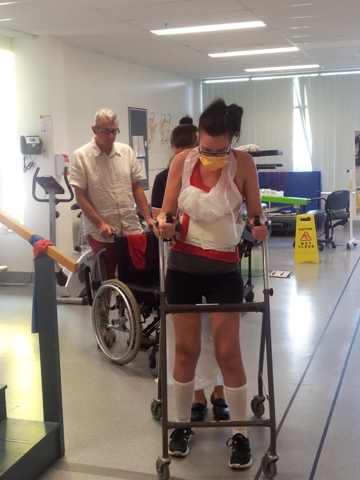
Please note, the picture below is the first picture I took standing up on my first outing. In the background is the Ross River...the bastard that may have caused the virus that caused the GBS!

Thursday, 10 January 2013

Mount Doom

'Well, the good news is that you don't have leukaemia or anything seriously nasty, but we're still awaiting further bone marrow results before we can determine why your neutrophils are so low'. Well that was a bloody relief to hear! At the time I didn't really consider how serious the low white blood count was, because I had some much going on with the GBS that I couldn't comprehend there was something even nastier going on. I was more concerned about getting home. Now I was physically improving, I was fit to fly, but because I was neutropenic they didn't want me to risk getting infected at the airport, the land of germs, and so it was a whole waiting game.

It was seven weeks that I had been in hospital and my parents and I were desperate to get home. For my parents, the stress of staying in a crappy motel, living off ham rolls and worrying about me was understandably frustrating and they were desperate to get back to their supportive friends and the rest of our family. For me, it was a real mix of emotions.

I wanted to be home, to see my brother and sister and my family and friends and for my parents to be more comfortable in their home environment. But also I was sad about going back. Here I was in Australia, the year of my big adventure. I was supposed to be travelling for four months, and as i write this now I should be in India, not sat alone in a silent house watching Louis Theroux documentaries by the dozen and eating disgraceful amounts of cheese. Some days it's really hard to think about the things I should be doing.

But look how far I've come! I remember at week seven I did my first walk along the parallel bars without holding on, nine consecutive steps without wobbling and grabbing the bars for support. By mid week I could do 64 side steps on each leg and I did my first walk along the middle of the room. I cannot explain how terrifying it is to walk unaided when you are so physically weakened. It's like being a tight rope walker over the fires of Mount Doom and someone has given you 50 shots of tequila and said merrily 'Off you go then...'

I started foot tapping on a 6cm high wooden block and the best thing of all? I was independent going to the loo. Using my rollator I could use the toilet in my room without anyone's help which was a great feeling. I remember seeing myself stand up for the first time in the mirror and it was a shock. I'd lost two stone that year, and in hospital I wasn't exactly chowing down the culinary delights. The muscle wastage in my arms and legs gave them an elongated feel, whilst my stomach looked bloated and bruised from all the injections. My pert rump of a bottom had sagged and I remember thinking 'People want to be skinny?! Where are my boobs and my hips?!' Since I've been home and off all meds and cooking lots of food for 'Occupational Therapy', it's all coming back with a vengeance but I love it. Hazaar for red wine and pasta!

Another plus of that week was that I could finally take off my TED socks. Oh the sweet relief! To not have the feeling of holes in my socks, to let my legs and leg hair fly free! And no more tummy injections! No more bowel medication! No more pain relief!

I'd moved up to 'medium' putty in OT and could get pegs in the wooden board with much more ease. I could Skype my best friend every night without falling asleep on him mid conversation and he would listen to every achievement ('Today I turned off the light switch!') with pride and encouragement. I was getting better every day.

But I still wasn't home.

Sunday, 6 January 2013

The Wince

I began to register that every time I said to anyone I was having some bone marrow taken that week, they would do that sharp inhalation of breath, their face would screw up and they'd wince. I asked my doctor for the truth; will it hurt? 'No no no' he said whilst nodding his head vigorously up and down. 'Oh L you're scaring me! Stop messing around, will it hurt?! What pain relief will I get?' 'Why, we'll give you a slug o' whiskey and a bullet to bite on'. Exasperated I laughed, knowing my doctor was trying to make light of my fears.

The day of the procedure I had L come and put the cannula in my arm before I was wheeled down to Oncology to have it done. Now, my Doctor L, and all the other doctors, were incredible at their jobs. But taking blood and putting in cannula's? Awful! L left me bruised all over when he had to take blood one day, and this cannula was a bloody nightmare to get in (more on that in a bit).

As I was wheeled in my bed, down the corridor and through doors after doors to get to where it was being done, I could see myself from other people's perspectives. Sympathy smiles as people looked at my face before quickly looking away. The only smiles I didn't get were in the Oncology ward. I can very vividly remember the face of a young woman with no hair, sitting patiently in the waiting room as I was wheeled by. We locked eyes. I suddenly felt extremely lucky that this was my situation.

I was hooked up to machines and for the second time I heard the sound of my own heart race. I began to count for the missing beat that I had, and was assured by yet another doctor that this was common. I was told to lay on my side, something that I could easily achieve by week seven and I proudly rolled over. I was told that they were going to inject me with some Midazolam which would most likely make me feel sleepy and woozy. So, they began injecting into my cannula, which normally doesn't hurt at all...but I could feel this pressure building and building and it really began to hurt. 'Oh no, it's tissued' - what now?! My lovely doctor had put the cannula into my skin, so when they began injecting me instead of the medicine going into my blood stream, it began to swell under the surface of my skin. Painfully they had to put pressure on my arm and take out the cannula and put another one in on my left arm instead.

It was a bad start, and I'd gone from being quite calm to extremely anxious. I was reassured and for the second time I was injected...ahhhhhhhh bliss. I must've slept through nearly the whole thing, apart from at the end. Basically, they make a tiny hole from your back to your pelvic bone, scape some bone off and suck it up (I'm not sure how medically accurate that it, but it sounds about right!) I think I woke up briefly in the sucking bit, sharp incredible pain making me once again aware of what was happening, but either they injected me with some more dazzle stuff or I passed out, who knows. When I came to at the end, I was very confused.

'Natasha, we're just putting a book under your back to put pressure on the wound and stop any bleeding'. I was still in twilight zone, and kept coming to and saying 'The book, the book! What about the book? Must I read a book?' I remember being aware that I was repeating myself, but I was so confused I kept thinking that this book was very important. When really, it was just a hard surface.

I was taken back to my room and given half an Endone, which I had pretty much come off by that stage. My parents came in to see me as I had the day off physio to recover, and although I ached all over it wasn't too bad really. I had built it up in my head to be much worse than it was, although to this day I can still feel a pressure if I stay in one position for too long, or lie on my right side.

The funniest thing was the day after, which was a Friday, and I remember lovely Sandra was helping me get dressed etc. And I was given a whole Endone tablet. I was high as a bloody kite! Giggling I got in my wheelchair and felt the best I'd felt in ages. How on earth had I been on those tablets at least one every four hours and still function? I was stoned off my face, and Sandra and I were cracking up as I made my way to the gym. Everyone had their concerned faces ready as they thought I'd be in a lot of pain that day...but instead I felt bloody great!


Sunday, 30 December 2012

Knickers Ahoy!

One word to describe being neutropenic - palaver. It was all systems go to figure out why my white blood cells, my neutrophils, were pretty damn low. It was really important that I wasn't put at any risk to infection as I had no cells to fight anything off, so the following precautions were taken:-

. I was moved back to a private room
. I had to wear a surgical mask whenever I left my room
. All staff were to wear gowns, gloves and masks when entering my room
. All equipment in the gym was to be wiped down with antiseptic wipes before I could use it
. I was not to enter the dining room but eat alone in my room for all meals
. I was taken off all medication that could make me neutropenic; it was goodbye to Gabapentin, my nerve pain relief, and on to Amitriptyline instead
. I was to have blood taken daily

The main problem was, the nurses did not seem to have a set procedure for what to do if someone is neutropenic. It seems ridiculous, but depending what nurses were on shift the procedure would change. Sometimes they wouldn't wear gloves or gowns or a mask, and as one nurse said to me 'I'm not ill, I don't have anything'...so, she could predict when she would become unwell? My lovely Norwegian nurses would always gown up completely when they saw me as a precaution, but lets face it, the hospital had air vents. I had to take my mask off to eat and drink. The germs would find a way!

It made me a bit paranoid at the time actually, I felt like I could see germs everywhere and I was scared of the smallest of sneezes. My doctors explained that if my neutrophil count were to drop below .5 then that's when they would really worry. On average, a persons neutrophil count should range from 2 - 6 (I'm pretty sure we're talking about the thousands here, not just a couple floating around!) The lowest my count was, was .7 and the highest it got to was 1.87, but never above 2. There was no sense to it, each day it would go up and down like a yoyo.

What was going on now!?

Physically, however, I was getting stronger each day, and it is incredible looking back at how fast I began to progress. As I began to move more, as I slept better, as began to have less and less pain, I began to feel hope.

By week six, on Monday, I did my first walk with a tall rollator. Five incredible steps, wobbly and unsure, but steps nonetheless. I couldn't believe it. By Tuesday, I did my first sit to stand without using my arms to push myself up. By the end of the week I walked with my frame from the gym to my room.

I remember this as being one of the toughest yet probably one of the most rewarding moments of my life. That Friday I told my parents to wait in my room at 4pm instead of coming to find me in the gym and wheel me back to my room. My physio's followed me with my wheelchair and they also put a walk belt on me to hold my trunk up ever so slightly. My eyes firmly on the floor, I took each step slowly but surely, sweating with my mask on. As I went down the corridor I dared not look into anyone's eyes, but in my peripheral vision I could see my nurses with ear splitting grins, patients smiling with encouragement and my physio's encouraging me every single step.

I walked into the room to my Dad with his phone filming every moment. I sat down in my chair and we cried and clapped and I felt so, so happy. Drained, exhausted, sweaty, shocked, but proud. I'd did it!

By the beginning of week seven I was holding onto the parallel bars and learning to side step. I could get onto bed without a slide board or push up blocks, but just one giant leap. I was lifting 1kg weights and doing fifty arm to shoulder flexes. I could lift my leg off the bed! I could pull up my own knickers!!!

But I was still neutropenic. I mentioned in a previous blog that I had one more nasty procedure to deal with. It was time to take some bone marrow...


Friday, 14 December 2012

Norwegian Nurses and Neutropenia

Turns out, I wasn't the only one getting fed up of nearly fainting all the time; my physiotherapists found it frustrating too, as it was very hard to get me to do...well, anything. It was time for blood pressure medication, Hydrochlorothiazide, to be taken at 6am and 12pm for optimum results. I also had to wear a velcro band, kinda like a corset but not in any way sexy, around my middle.

Drugs work. For the first time, I could finally sit up without feeling dizzy, and this really helped with...getting better. I began to get some small movements back in my arms and legs by week three, and by the end of the week I could use a slide board to get from bed to wheelchair with a two person assist. I would have to lean forward and put my head on my physio's shoulder, and another physio would help lift from behind and we would slowly shuffle/slide me to wherever I needed to be.

I had trouble trusting the nurses to slide board me, and as I had been moved out of my own room to a ward full of people, I always felt like there was the pressure of being watched (although its not as bad as people watching you swing helplessly on a hoist). The nurses expected me to be able to do more than I could and I felt like I was just going to go crashing to the floor!

Lucky for me, I had three beautiful nurses who were always there to look out for me. If you are unlucky enough to end up in hospital, trust me when I say, if you have these three looking after you, you will get better in no time! Three student nurses from Norway were on their placement in my Rehab ward, and they arrived the same day as me. Pia helped me with my first slide boards and was incredibly patient, strong and also not afraid to tell off any of the other nurses for sliding me wrong! I had Pia almost every morning to help set me up for the day, and she always made me smile (especially when she would try her English accent out on me...'Wud ya like a cuppa tea!?' Brilliant.

I also had Sandra and Rikke, friends and housemates with Pia, who would braid my hair for me and chat about travelling and music and normal things. There are only so many games of Scrabble I could play with my parents, and we were all going a bit stir crazy! So having these three nurses, around my age, to talk to me and treat me as a person, not a patient, meant a lot to me. And they were all fantastic nurses, talking and smiling and caring for everyone. Thank you ladies!

By the middle of week five I could slide board with just one person assisting. And something else amazing was happening. I was learning to stand. A physio to the front and two either side of me was how we did it at the beginning. Two would push me up and hold my legs whilst I put my hands on the physio in fronts shoulder. Learning to stand again is HARD.

'That's it Tarsha, brilliant! Legs bent, tummy tucked, shoulders forward, head up, squeeze your bottom, lean to the left...too much, back to the middle...come on Tarsha, keep holding!' 'I'm standing!' I yelled! Everyone in the gym turned and smiled at me, and calls of congratulations were echoed throughout the gym. Triumphant and exhausted, I sat back down after around a ten second stand. Five weeks of not walking, not moving, learning to do everything again...and I had stood.

Being naturally very flexible, it was so confusing to learn how to stand. My legs would snap back like solid bananas and I couldn't grasp the concept of 'soft knees'. My back would arch back and I would thrust my chest forward trying to find my balance. My poor front physio would generally get a knock in the head as I fell forward, and it was incredibly difficult to try and find my balance.

But I was finally getting somewhere. All those exercises I had been doing for two weeks were beginning to pay off, and I trusted the physio's 100% when they helped me to stand. Despite the pain I was ecstatic, I couldn't wait to tell my parents I had stood for the first time! By the end of that week it was only one person helping me stand as I would push myself up on the parallel bars. It was great to have some use of my arms again.

But then they did a blood test. And my doctor came up to me one morning on this fantastic week five and said 'We need to move you back into your own room. Your white blood cell count is extremely low, meaning you're neutropenic. We don't know why...'

Crap.

Monday, 10 December 2012

Vomcano

"On no, please can I have a sick bag?"
"Yup, just hold on...one second...hang on...here we go"
"Thanks...bluuuuuuuurgh bluuuuurgh bluuuuuuuurgh bluuuuuurgh...blurghblurgh...blurgh. Right, anyway, where were we?"

I was getting pretty good at the old tactile voms. And also used to talking about poo and being naked in front of people (gosh I do make hospital sound like bags of fun). I was having my shower assessment done by my Occupational Therapist, lets call her K. She chatted away merrily as I attempted to scrub my body with my T-Rex arms, sitting in the shower chair and occasionally throwing up. Squeezing bottles was ridiculously hard at that early stage, but I surprised myself at how much I could do. I could even hold on to the shower head and spray down towards my numb little toes, un-moving and pale below me.

The aim of Occupational Therapy (OT) is to get people back into being independent, doing normal things even if it was eating with built up cutlery or making themselves a cup of tea. During my shower assessment K explained to me that it was easy to get the nurses to just wash me, because I was so exhausted and everything took so long, but every day I had to try. There were few victories those first few weeks, but as time progressed the small things started coming back. Oh, it was a proud, proud day when I could open the cap on my toothpaste.

In physiotherapy I was doing some basic exercises in the gym, with assistance. A simple task like pulling my knee into a bending position required a physio to support my ankle with one hand, and slowly ease up my knee with the other hand whilst I tried as hard as I could. It's bizarre really; I would look at my legs and try so so so hard to bend and move them, but it just wasn't happening. However, with the physio support I could feel my muscles screaming and trying their best to do their job. By doing sets of ten for each exercise, and building up by ten each day, I would eventually gain control back. And I say eventually.

My notes for week three go like this: -

'Sets of ten in gym with help. Pain. No movement. Shower assessment. Fucking hoist.'

I think the starkness of these notes are self explanatory. I tried to take strength from the other people in the gym (I won't name names), but there were people who had had amputations, strokes, brain hemorrhages, car accidents, diving accidents and other strange neurological diseases. It sounds terrible to say, but at least I knew I was going to get better. People, going through much worse than I, who had been there longer than me, would still stop and smile and say hello.

I think it comes down to one thing, one human trait that we all have. People have said to me I have been brave, that they couldn't have gone through what I've been through. Truth be told, I cried every day. For weeks. I still cry now for goodness sake! But you know what? In the words of Regina Spektor, "People are just people like you".

And you just get on with it.


Monday, 3 December 2012

Rehab

They tried to make me go to rehab...and I said yes, yes, YES. Despite being unable to move, I was swiftly transferred down to the Rehab ward after only nine days of diagnosis and treatment. I was sure I'd get to the gym, miraculously stand up, start pumping my guns and soon be as fit as a horse. Either that, or they would take me out the back and do what they do with horses whose legs no longer work...gulp.

I had become on friendly terms with my nurses in Medical Ward Two, and they affectionately called me T-Rex. One of the nurses who used to dress me would ask me to lift my arms in the air to pop my T-Shirt on...oh how we would laugh. 'Sorry T-Rex, I keep forgetting you can't do that!'. Because I had quickly become so familiar with these nurses I felt like I was leaving friends and going to a big school with scary new people. It was fine. Mostly.

I was wheeled down to my very own private room, complete with a shower room and a window over looking Subway. Lovely. Actually, it was all rather exciting. My Mum decorated my room with photos of my friends and we were all quite positive. The thing with GBS is, only you can get yourself better; yes I had the five day transfusion, but it's only with physiotherapy and perseverance that I would recover.

Whilst I had the right attitude and was willing to work hard, I had a slight draw-back. Pain. When I went down to Rehab, I started to get excruciating headaches. Fortunately, I had never suffered from a migraine before, but now I have complete empathy for people who get them. I was told that the Lumber Punctures could have caused these headaches, but as I was to suffer through them for weeks to come, that began to seem like a less likely option.

Along with utter exhaustion, nerve pain and crippling headaches, I found those first few weeks a nightmare. I was sleeping a few hours a night, relying on medication to knock me out, but waking every half hour or so to buzz for the nurses to roll me over. Not being able to roll over in bed or pull my legs in when they fell out of the side rails was simply awful. I began to dread the nights, knowing they would drag on and on. I would beg for pain relief all the time and by the time morning rolled around I was spent.

And I had an early start. From that first day, I had a timetable made up which meant I had a full day, from 8.30-12.30pm I would be in the gym, then from 2-4pm I would be in, that's right, the gym. I also had Occupational Therapy (OT) for an hour a day as well. Let me tell you now, it would be almost 7 weeks before I was on time for 8.30am!

Being that I could do nothing, I would have to wait until some nurses were free to hoist me into the shower. By the time I was showered, dressed and ready to go, it would be around 10.30-11.00am and I would be wheeled to the gym. I was to become to close to one nurse in particular, and overtime we had our own little morning routine, but more about her later on.

When I talk about the gym, I obviously don't mean your regular fitness centre. This gym involved parallel bars, tracks along the floor, arm bikes and tilt tables. Apart from all the equipment, you have the physio's. I cannot praise them enough, each and every person in that gym was fantastic. I was lucky enough to have the head of the department in charge of me, and I knew straight away there would be no messing around. Firm but fair, I would be pushed and encouraged from day one.

I had Thursday and Friday that first week and I tried so frekking hard. We would practise my sitting balance and I would be swung over the edge of the bed where I would reach out to the hands in front of me and try desperately not to fall face first over the bed. I would also spend time on the tilt table. This is where many problems began.

I am tall. Not crazy tall, maybe just above average around 5ft 9". But my height meant that my blood pressure would plummet very quickly, leaving me dizzy and sick. A tilt table does what it says on the tin; I would be strapped in, then slowly we would tilt me up. The aim was to get to a standing position to get my body used to being upright and also put some pressure onto my feet. Could I make even 50 degrees? Nope. My face would apparently drain of colour and before fainting I would be lowered back down. This was only the beginning of the blood pressure drama, and it soon became apparent that this was yet another problem.

I felt lousy. I could do nothing in the gym but faint, and OT? There was a peg test, nine innocent holes in a board and nine thin, smooth plastic tubes. The aim? Put the pegs in the holes. Sounds easy right? I couldn't get one in. I would pick one up, drop it, try and pick it up again and do the same. I came down feeling positive, but I soon felt like shit. I knew it was just the beginning of recovery but I was angry and tired and fed up of constant pain. It is so unbelievably hard to be positive when you are in agony.

My drugs were increased. I was weaned off the Morphine and began taking Endone, a strong opioid that would help my headaches but leave me drowsy and nauseous. I was also taking my normal bowel medication and having Clexane injections in the stomach each day to thin my blood to help prevent Deep Vein Thrombosis (I also had to wear TED socks for this...more on them later). I was taking Paracetamol, Ibuprofen and OxyContin. I later found out OxyContin is a highly sort after drug in Canada and is extremely addictive...you know it's good if the Canadians are after it! I was on Gabapentin for my nerve pain relief, not that it helped much.

I quickly became depressed and fed up. I felt like I was never going to get better. If I hadn't had my parents with me I think I would've easily slid into some serious depression. I couldn't imagine moving my legs or using my hands again.

But I was sure as hell going to try bloody hard.


Friday, 23 November 2012

Mum

My Mum is awesome. Having her by my side, along with my Dad, made this whole hospital experience bearable. Hugging my Mum for the first time was emotional for the both of us, and I remember being very aware that, like when I hugged my Dad, I couldn't wrap my arms around her.

Despite this being the first time my Mum had flown such a long distance alone, she explained that during the flight she felt calm, happy to know that she was on her way and not at home waiting. I think that seeing that I was still me and was talking and acting the way I normally would reassured my Mum at the time; in many ways she had drawn the short straw by staying at home as she couldn't physically talk to me.

My Mum arrived on a Tuesday, a week after my Dad, and she came bearing gifts and cards from home. I remember trying to open one of the envelopes but it was too hard...overactive hands and weakness would hamper all my attempts at simple tasks, like opening a bottle of water. Mum had decided to spread the gifts out over the week, an excellent decision as everyday was 'Treat Day'!

Having my Mum around was not only great for obvious emotional support, but also for practicalities. No offence Dad, but your attempt at hair brushing was a bit scary! Not that I don't appreciate the effort, of course. Mum would go on to help me shower and other essentials, as well as paint my nails and pluck my eyebrows to make me feel more human.

Because I felt disgusting. Is there anything more unattractive than gym shorts, greasy hair and eyebrows so long they could be trained to grow into a beard? I think not. Another thing my Mum did was exfoliate my hands and feet. Ah, the sweet relief this would bring. Having been reading Melanie Reid's 'Spinal Column' in 'The Times' every week for a few years, my Mum had picked up some tricks. Melanie Reid fell off a horse in 2010 and broke her neck and back. Incredibly, she has since been documenting her recovery each week, which was part of the inspiration for me to start this blog. Mum had unknowingly been picking up tips by reading this column, and one thing that stuck in her mind was Melanie's exfoliating.

As I have mentioned I was experiencing unrelenting neuropathic pain in my hands, and eventually my feet. When my Mum first got a warm bowl of water and gently started exfoliating my stiff hands, it felt good. By the time she had finished and they had been patted dry, it felt like I had new hands. They were light instead of heavy, smooth where they had been rough and that cold burning sensation? Miraculously gone. Whilst this blissful relief only lasted for 5-10 minutes, it was nonetheless a wonderful feeling from that constant pain. If you are reading this and you are suffering from any similar neuropathic pain, I would recommend trying this out; if you find you get some relief repeat the process around 2-3 times a week (you certainly don't want to rub yourself raw!).

I am so lucky to have such great parents. My Mum would patiently exfoliate me and rub my aching shoulders. For the first time ever she could rub my feet, the one good thing about being paralysed; normally I am so ticklish I can't let anyone touch them! Mum would keep me up to date about everyone at home and the news and all those little things that would keep me going. She is such a strong woman, and it's amazing to think how she took everything in her stride. Thank you Mum.

As I was still in a ward on my Mums arrival, we would do the standard walk around the hospital grounds. Then, on Thursday we came back to my bed to find a bunch of nurses with boxes of my stuff...'We're taking you down to Rehab'. Eek!


Sunday, 18 November 2012

The Hoist

My very first wheelchair was a beast. Known as a 'Tilt and Space' it was perfect as it could fully recline and was completely adjustable. My sitting balance at the time was wobbly so those first few walks (or rolls) around the hospital grounds with Dad were great because I could fully lie down for a rest whenever I needed to.

And I needed a lot of rest. Because I could do nothing for myself, the smallest thing like going to the bathroom would be a huge exhausting obstacle, often resulting in tears, near fainting or vomiting. Sometimes all three. To get to the toilet and shower for the first 3-4 weeks I was hoisted. The hoist...how does one describe such an evil yet useful contraption? It's basically a crane with an attachable sling/hammock and this is how it works in ten easy steps:-

Step One: Buzz for nurses and wait for ten minutes or more for them to find two people who could use The Hoist.
Step Two: Be rolled side to side like an uncooked sausage roll that needs longer in the oven, whilst they arrange the sling underneath you.
Step Three: Be hoisted into the air, usually at a wonky angle on the third attempt.
Step Four: Be lowered into the shower/toilet chair whilst head gets banged and toes get caught in crane device.
Step Five: Be pulled, pushed and lifted for the sling to be removed.
Step Six: Use the toilet/shower.
Step Seven: See Step Five in reverse.
Step Eight: Be lifted into bed with sling chafing legs, no knickers and some tears.
Step Nine: Step Two in reverse.
Step Ten: Repeat process as the whole thing took 45 minutes and you need the loo again.

I hated that frekking hoist.

Using the toilet and having a shower turned into a humiliating debacle and I am going to write honestly about it, because there would be no point in me writing this if I wasn't truthful. So here we go...poo. Everyone poos (yes guys, girls poo). As it turns out, when you are immobile your system tends to clog up, and the nurses and doctors are OBSESSED with poo. "Have your bowels opened today?" is something that I was asked around three times a day. As I wasn't moving around, they fed me full of laxatives:- Coloxyl with Senna tablets, Lactulose, Movicol and Pear Juice were to be taken twice daily. Lactulose is a very sweet substance, but tastes disgusting, as does Movicol which is a very salty drink. So GROSS. And Pear Juice? Bloody VILE. Sometimes I would be physically sick after drinking these...but they worked.

All the dignity I had left was taken from me when I could literally do nothing in the toilet. I would be heaved left and right to get my under-crackers off and a nurse would wait listening outside the door in case I fell or fainted off the loo. I would then be wiped by a nurse. I feel this should be embarrassing to write about, as basically everyone I know is reading this blog. But this happened to me and it was horrible, yes, but I'm not going to pretend it didn't happen because it did. I will not feel ashamed by this illness. For weeks, I could literally do nothing.

Showering was another task although I wasn't bothered about being naked in front of my nurses, but it was more the absolute exhaustion it would cause. I would sit in the shower chair whilst a nurse would wash me and my hands would, and still feel, very thick and slow in hot water (thankfully I can still feel hot and cold). If they washed my hair, which has gotten stupidly long, it would obviously take that much longer and I would be swaying in the chair by the end of it. Hoisting me into bed, naked and damp, was shameful and painful. The nurses would then attempt to untangle my hair and I would be completely wiped out, often succumbing to a nap straight after.

Everything I did was tiring. Dad would help to feed me and take me for little walks around the hospital, reclining me and ensuring I was comfortable. Our days would zoom by with the aforementioned tests in my previous post, and every tiny thing took so long. Dad kept me entertained with stories of his past and even started reading 'The Last of the Mohicans', one of his favourite books, to me. I remember one particularly bad morning, before we even had the wheelchair, and I was screaming and crying and banging my head on the pillow; I couldn't bare the thought of another day lying useless in bed and I was having a bit of a breakdown. Did my Dad get exasperated or stressed or flustered? Nope. He held my hand until I calmed down and let me cry it all out. Then he'd cheer me up by making up a song about GBS and I'd join in and we'd start laughing.

I would talk to my family at home each day, and my Mum had decided to book a flight. Before she arrived, my Dad and I were extremely anxious but also very, very excited. The day of the flight, Dad came to see me in the morning before going to meet Mum at the airport. I was having one of my first sessions with one of the physiotherapists, which was going pretty terribly as I recall she tried to get me to do squats on a tilt table (more about those later), when I heard voices. And suddenly there she was. My beautiful Mum.

Wednesday, 14 November 2012

Rabbit Hole

Pain. We've all had it, both physically and mentally everyone alive has surely suffered pain, from those minor bumps to broken bones and broken hearts. To describe neurological pain is like trying to find the words to describe 'pink' to a blind person. Along with extraordinary back pain and muscle ache from lack of use, those first few weeks in hospital I suffered terrible, non-relenting pain in my hands. A constant cold burning started in my hands a few days after I began treatment and I would be constantly rubbing my hands together even though it bought no relief. My hands would feel stiff, swollen and twisted; I had no sensation and a tingling feeling like buzzing bees trapped under my skin.

When I look back at how much pain relief I was on, it's amazing I could even communicate. I'd had morphine before after major knee surgery when I was nineteen years old (I haven't had much luck with my legs!), however it was a tiny amount in comparison to the amount I was on when I first got to Townsville. I guess an average was around four morphine injections a day along with other pain relief, and whilst morphine makes everything mellow and distant, it did not touch the pain in my hands.

Lucky for me I hardly had a moment spare that first week so I had no time to dwell on my pain. I had neurological doctors, physiotherapists, occupational therapists, speech therapists, dieticians, medical students, nurses and an Infectious Diseases team come to see me frequently throughout each day. And this doesn't include all the tests! I had an MRI Scan, a Heart Scan, my second Lumber Puncture and a Nerve Conduction Study all in that first week.

When it came to the MRI scan I was told to lie completely still...lucky for them I couldn't move so that was easy enough. They put my head in a kind of Darth Vader mask after taking out all my ear piercings and zoomed me back into the scanner. It took AGES. Lying still and listening to the loud thumping of the machine was hardly relaxing, especially when they kept interrupting to say "Can you still breathe okay? You must tell us if you can't breathe." Yes, I think that is definitely something I would bring up. Afterwards I had to wait for what felt like a long time before I was taken back up to the ward to my ever patient Dad. Crying (those first few weeks I cried more than Alice when she got stuck down the rabbit hole) I babbled to my Dad about my aching and weary bones as he joked and comforted me.

The heart scan was a similar experience to the MRI, in that I had to lie still and listen to a lot of thumping. This time it was my heart beating away on the screen as the technician slavered me with gel, like an ultrasound for a baby, and spent time making notes and doing lots of important looking stuff. From the beginning I have had a high heart rate, averaging at around 120 beats per minute at rest. One day it was 180 and I was just chilling. I have to explain to each new person when they go to run for the ECG machine (I also have an irregular heart beat) that it's all good, it's just the combination of Guillain-Barré Syndrome and low blood pressure that makes it fast. They still like to do an ECG once in a while, just for fun.

At the end of the week I did have to have another bloody Lumber Puncture, which as I have mentioned in an earlier blog, is hardly my idea of a good time. My Dad wanted to sneak away for this part but stayed to hold my hand after seeing how scared I was...and also after hearing me hiss 'You're not going anywhere!' All in all, the second one was a bit of a laugh. One of my doctors, who had the biggest smile, was doing the procedure this time and after injecting my spine with local anaesthetic he swiftly started draining fluid. As the doctor from the previous lumber puncture came to have a look whilst it was being done, I took the piss and said 'This guy is much better than you, he got fluid on the first go!' Oh how we laughed and made jokes about the clarity of the fluid taken (it was completely clear, no drops of blood or anything). It actually looked like vials of vodka, and to be honest the amount I used to drink, it was probably just pure ethanol they were draining. Because my Dad was with me as well it was all a lot less traumatic than the time before. Unfortunately, it was far from the worst procedure I had to have, but that comes much much later.

The final test that week was a Nerve Conduction Study. Eurgh. All four of my neurological doctors were there and a technician; they'd explained what they were going to do before and that it didn't hurt at all. They lied. My Dad sat down after some chit chat and they began. They would put a needle, connected to wires and a computer, on part of my arm or leg and basically give me a little electric shock, where they would measure the delay in the electrically stimulated reflex. I remember understanding parts of this, for example they would say 'Well this here should be 9 but it's only 4'. Basically recording the prolonged or absent waves and the conduction, to test if it was slow or blocked. Interestingly each reflex they tested, even in the same leg, would show different signs of damage.

As my nervous system was damaged they would call this a demyelinating disease, because the myelin sheath of neurones had been damaged. They explained that some of my nerves were just bad on the outside, however I also had some axonal injury as well, meaning that the inner nerve was buggered as well. Imagine a normal wire with its conducting rubber on the outside; a bit of wear and tear on the outside doesn't matter too much, but if the inside wires get frayed or whatever, then you may have to invest in a whole new wire. Lucky for me, I wouldn't need re-wiring, but the recovery time would be longer simply because it would take a longer time for these badly affected nerves to heal.

Needles and electricity are a nasty match and I was very uncomfortable during the whole process. I was so lucky to have my Dad there to explain in normal speak the doctors diagnosis. Basically, my nerves were a bit fucked. The study confirmed their diagnosis of Guillain-Barré Syndrome, as did the second lumber puncture which showed high protein levels. My MRI Scan and Heart Scan were all good, a big relief.

The plan was to finish the intravenous transfusions to a total of five days, and then get me down into rehab to start the recovery process. I felt relieved that eventually I would recover, but the sinking realisation that I definitely would not be travelling those next few months left me devastated. I was still physically worsening at this stage as well and sleepless nights made me exhausted and depressed. Not to mention the hospital food, yuk!

Regularly talking to my incredible family at home and having my Dad around helped to keep me as positive as I could be, although usually I would have a roller coaster of emotions each day, from absolute meltdowns to making up songs about GBS with Dad (generally to the songs of 'Beauty and the Beast'). My Mum was talking about coming out as well but Dad and I were anxious about the added stress she might have flying out alone, and also we thought we'd surely be back in England in a few weeks. Writing this as I am, still in Australia eight weeks later, we were very bloody wrong!


Sunday, 11 November 2012

Wiggle Big Toe

"I have to go, my Dad's here, my Dad's here!" I put the phone down sobbing as my Dad came rushing towards me. I don't think I have ever felt both so incredibly sad and happy as I did that moment. I tried to reach my arms up to hug the man I'd not seen for seven months, but had to make do with a head tilt on his shoulder as he enveloped me in his arms. I had never seen my Dad cry before (although to be fair I looked a bloody state! ECG machine taped to my body, crazy sea salt hair and a hospital gown is enough to make anyone weep).

Laughing and crying we quickly gained composure and I heard about Dads thirty-five hour flight from hell. He actually happened to meet a doctor on his flight who knew about Guillain-Barré Syndrome; trust my Dad to get chatting to probably the only person on the plane who'd heard of it.

To have my Dad by my side made me feel calmer, for here he was to listen to all the medical jargon with me and support me. It was a bloody good job he arrived when he did as well, because that week I was to have an array of medical tests that were physically and mentally exhausting.

One stand out memory that shocked my Dad and I, a memory that made us realise how bad things had got, was when my Dad and a nurse tried to help stand me up so I could get to the loo on a shower chair. The day before I had done it but this time my legs completely collapsed beneath me; my Dad called for help as I lay in a twisted heap on the floor, crying, toes caught in the chair and nothing I could do about it. Several people appeared and I was lifted back into bed and from that day on for many weeks I said goodbye to dignity and hello to bedpans and hoists (but more on them later).

You know the scene from Kill Bill, where Uma Thurman is staring at her toes saying 'Wiggle big toe...wiggle big toe' and miraculously it wiggles? Well, in reality this doesn't work. As that second day progressed, so did my symptoms; I would stare at my feet pleading with them to move, for a toe to twitch, begging for a sign of life. Nothing. Then no leg movement at all. Then I couldn't lift my arms off the bed. I couldn't feed myself, move myself, roll over. All I had was that floppy arm flex from wrist to elbow, shoulder shrugging and head movement. Even my speech began to suffer mildly as time went on...the effort to talk was sometimes challenging.

It's a strange thing to loose all your independence in a matter of days. Imagine needing someone to do literally everything for you in the bathroom, someone to dress and undress you, someone to put a glass of water to your lips to drink. I actually found the worst thing was not losing the use of my legs, but actually losing all the power in my arms and hands. I couldn't distract myself with a book because I couldn't hold one...three chapters left of 'Game of Thrones' and I couldn't finish it...agony! Imagine being put in a position to sleep in, but after five minutes everything aches and hurts and you can't move at all. I am generally a very fidgety person, especially at night, so for weeks I had to keep buzzing the nurses to come and roll me over.

Having my Dad, and later on my Mum, around made everything better. Dad would feed me and move me, but best of all he took the piss out of me! We actually had such a laugh at the whole situation; a classic moment was when I was trying to screw the cap on a bottle of water, trying to use all of the strength I possessed with the only movements I had, and could I do it? No way! I kept dropping the lid because I couldn't feel it, and although of course there were many tears of frustration, having Dad around made me laugh. A lot.

Sure enough, my Dad soon became on friendly terms with all the doctors, nurses, patients, bus drivers and pretty much everyone he came into contact with. I would regularly be told 'Your Dad is so lovely!' and I couldn't agree more. He would arrive early in the morning and leave late at night and I felt, and still feel, very lucky that he was there for me from the start. Cheers Dad!

Monday, 5 November 2012

Weak

Waking up after my first nights sleep in Townsville Hospital I had a chance to really think about what was happening to me. It was Monday morning, I had strange tingly numb sensations in my hands and feet, I could hardly lift my arms and walking was a struggle. I admit, I felt sorry for myself. I remember thinking about my family and how worried they would be; and the chance that whatever was happening could get worse and I could even stop breathing...I couldn't quite take it all in.

I felt sick from fear and turned down an uninspiring breakfast of cornflakes. And then suddenly the day started. Four neurological doctors closed the curtains around my bed and began to introduce themselves, doctors that I would quickly become familiar with.
The thorough exam that they then conducted that day and there after many times a day for the first few weeks, became something that I knew backwards. They would start with my arms most times, seeing how high I could lift them, how well I could flex from wrist to elbow, how tight my grip was as I squeezed their fingers. On day one, I could still lift my arms off the bed by a few inches, however my grip was incredibly weak and my wrist to elbow flex had no control; my arm would flop inwards towards my torso.

They would then move down to my legs to see if I could bend and lift them, which again I could do at this stage, albeit with much effort and little strength. I remember being pleased that I could still wriggle my toes, although pushing my feet into their hands and then pulling them up towards my body was a massive chore. One of the doctors carried out the tests the others would be making notes. I was baffled by the way they recorded the results with numbers and words I didn't understand, although I would begin to understand their scoring system as the week continued (believe me when I say it was not as simple as 10 being strong and 1 being weak!)

The next step would be to use the reflex hammer. Still no sign of any reflexes in my arms or legs. The doctors murmured. They then used the pointed end of the 'hammer' to scrape the sole of my foot; could I feel that? Yes, but faintly, as if through layers and layers of thick skin. "Natasha, we believe that you are suffering from Guillain-Barré Syndrome but we need to do some further tests. GBS is a disorder that affects the nervous system and causes temporary paralysis. Your respiratory muscles can be attacked which is why you must tell us straight away if you find it hard to breathe or swallow.' I'd heard this the day before but it still didn't make any sense to me. I desperately wanted someone with me who could comfort me and tell me I'd be okay.

The doctors continued to explain more about GBS and asked me if I had been ill prior to experiencing these sensations, as it is usually caused by a viral infection, even something as simple as a cold can trigger GBS. The strange thing in my case is that I was not unwell before my toe went numb. I had no cold, no fever, no sickness. Each case of GBS is unique and there is still a lot unknown about what actually causes it, but to not be ill beforehand was unusual.
They explained that in the afternoon they would do a lumber puncture to test the fluid in my spine to help confirm their diagnosis. I welled up. I'd heard and read of the term 'lumber puncture' before and it was another thing to worry about.

That day I saw so many different people and repeated my symptoms a million times over. Time was doing that strange thing where it speeds up and suddenly it was time for the lumber puncture. Thankfully I had two nurses to hold my hands and distract me as I was manoeuvred into a foetal position. Two of the doctors I'd met earlier were back and one explained that he was going to inject me with a local anaesthetic into my lower spine which would numb the area. I whimpered "Please distract me" to my nurses, and they reassuringly chatted about this and that, their children and their normal lives, something that already felt far from my new reality.

After the anaesthetic I was told another needle was going in to try and get some of the fluid out. It didn't work. He pushed the needle in further and I could feel a dull pressure, stabs of pain and I began to cry. "I'm sorry Natasha, we're going to have to get you to curl up as tight as you can and we're going to have to numb the area and start again". I tried to be as brave as I could be, feeling like a small child. He started again. For what felt like a long time he poked and pushed into my spine until I heard him say it was working and the fluid was coming; I was so relieved when it was over and I had the sweet relief of morphine injected into me. Unbeknown to me at the time, that would not be the only lumber puncture I was to have that week.

As the day continued I progressively got weaker, and from being able to walk with assistance to the toilet, I could only do a stand transfer to a toilet chair. I didn't know that this was to be the last day I was able to stand for five weeks. Pain that had been hovering in the background began to breakthrough; the tingling in my hands began to burn cold, again a sensation that would strengthen over those coming weeks.

That night I was told the fluid taken from the lumber puncture could not confirm the diagnosis of GBS, however they were going to start treatment that very evening as if it was this as it could do no harm to begin. They hooked me up to begin administering intravenous immunoglobulins (IVIg) which would neutralise harmful antibodies and effectively stop the GBS from spreading further. I was told to expect to get physically worse despite the beginning of this - they were right.

I went to sleep that night focusing on one saving grace...the next day, my Dad would arrive.

Friday, 2 November 2012

Helicopters and Nunga-Nunga's

The helicopter crew. One word: Phwoar! Like a scene from ER they strode in looking purposeful and important, swiftly transferring me from bed to stretcher as casual as cats. One of them picked up my (rather large) rucksack, 'Crikey, what the hell is in this thing?! No wonder your crook carrying this around!' I should point out here that I have used a little poetic license, as rarely have I heard an Aussie say 'crikey' before, although 'crook' is a common term for being unwell.

Banter continued from the crew on the way to the helicopter and I laughed along nervously. The female doctor in charge turned out to be from London, and as I was pulled aboard she explained that I would have to wear headphones and that an observation machine would take my blood pressure and heart rate every fifteen minute. She said if I needed their attention I should just look up to them, being that I was positioned on the floor and could hardly lift my arms to wave at them. I was told if I found it hard to swallow or breathe I must let them know straight away; I would get used to hearing this over the next few weeks, not that having this repeated throughout the day made it any easier to hear.

Never having been in a helicopter before, I was very intrigued. As the blades started whirring above the doors were closed and suddenly we were lifted into the night. I'd been told to try and relax and sleep for the hour long trip, and as I couldn't see anything I thought I would attempt to do this. Of course, my brain would not switch off.

Now, I don't know if this was vanity or some kind of coping mechanism, but I spent the majority of the flight not worrying about this Guillain-Barré business, but instead worrying about my boobs. Having had to take off my bikini top for the CAT scan I suddenly realised I was in extreme danger of popping out. Christ! What would I do if a nunga-nunga came out?! Would I ask a crew member to pop her back in? What if i asked and they couldn't hear me and in gesturing with my head the other bazooma made an appearance? What if they didn't notice at all? What if they did notice and pretended that they didn't? These were SERIOUS CONCERNS. I wasn't thinking about the fact I could be paralysed and stop breathing at any moment.

Thankfully the girls behaved and stayed out of sight and suddenly we were descending, practically dropping to the ground and the flight was over. It hadn't seemed real that hour, and the fear that I had been pushing back started to rear it's ugly head. I couldn't quite believe this was actually happening. I had just been flown to Townsville Hospital because the doctors were worried and this situation was serious; thoughts of jiggling boobs disappeared.

As they transferred me to the Emergency Department and again easily slid me into a bed, I remember suddenly feeling utterly exhausted. The memory of this night is a blur of questions, observations, reflex tests, blood tests and eventually a transferral to a ward around midnight.

I spoke to my family, having discovered that my Dad was flying out that day and would get there Tuesday, and I explained I was in a ward called EMU. Now, this being Australia I found out much later on that my Mum was relieved I was moved to a 'normal' ward. She (and I) didn't realise it actually stood for Emergency Medical Unit, but at least she had some sense of relief at the time!
I fell into a deep sleep that night despite observations every few hours, and this was actually the last good night I remember having. For after that night, despite being in hospital and despite the incredible care I received from the start, things were about to get worse. Physically and mentally, a hell of a lot worse.