Friday, 10 May 2013

Running Up the Stairs

'Where's my helmet?! My fluorescent jacket?! Gah, I'm gonna be late!'

I run around my house, looking for daily essentials before my ride to work. I leap up the stairs, brush my teeth and bound out the door to get on my bike to cycle the 25 minutes it takes to get to work. I work eight hours and ride home. I get in, sometimes I cook, I watch a show, read a book, have a glass of wine maybe, and then I sleep.

At the weekends I go out. I dance, I drink, I cycle, I see friends, I walk, I eat.

As you know, nine months ago, I couldn't roll over in bed. I couldn't eat a grape. I couldn't play Halo. Let alone walk. Guillain-Barré struck me down and I thought that was that.

It's a weird thing to look back on. I wasn't going to write another blog, feeling that my journey with GBS had mostly come to an end. Fifteen thousand blog views, emotional Facebook updates and six months later, I was feeling pretty alright. But it doesn't really work like that. It's something I think about every single day. I could be on the train listening to music, when I suddenly remember being told GBS is potentially fatal. I could be laughing with friends about nothing at all and my feet will start to buzz gently under my socks. I could be shopping in town and I'd flashback to being in hospital saying 'I just want to do something normal like go to the mall'.

My friends look back on their last year; they talk about the travels they've been on, the people they've met, the new jobs they now have. They can move on and occasionally think 'Shit, what happened to Tarsha was mental' when they see someone in a wheelchair. I find it hard to look back. The new jobs I've started, the explanation I give about GBS, the shock on people's faces and then the worst bit...the admiration and the 'You've come so far'. I'm of course not angry with these people, I'd be the same in their shoes. But many people just don't really get it.

The expression that I hate the most, that I utterly despise, is 'Everything happens for a reason'. The most patronising expression for those lucky people who haven't been through shit. I hear 'Oh you must appreciate everything SO much now' and even, unbelievably, 'Wow, like, I know what you've been through must've been pretty awful and everything...but you know, it's kinda cool that you've had that, like, life experience, you know?'

It is not cool. It is not an 'experience'. It is a process of pain, endurance and misery. I don't know what I've got out of it. I read about people who had GBS who have run marathons, climbed mountains or have had kids and talk about how they are stronger because of what happened to them. I am extremely happy for these people; it is not everything happening for a reason, but it is because they are people who have been determined to make something good out of an awful 'experience'.

Me? I'm taking it slow. I'm planning a holiday to Italy with my best friends, a festival and hopefully, eventually, a trip to Canada to be with my incredible boyfriend. Every day it is hard to remember. But things get easier, as they always do with time.

For now, I still try to remind myself of the small things that really do matter, and I find myself smiling a bit more. And really and truly, right now?

I'm just happy I can run up the stairs.

Monday, 11 February 2013

Living

An ambulance picked me up from Heathrow Airport and we started the journey home. It was grey, cold and raining, typical England. I said goodbye to both my nurses who flew me home, and I couldn't have asked for better care. I would recommend Sainsbury's travel insurance to anyone, they were incredible; the whole flight home my Mum and I didn't have to worry about anything. I was in Business Class so I could lie down, and the nurses worked in shifts to check my blood pressure and help me walk to the plane toilets etc. They were also such lovely, kind women, and my nurse Henry still texts my Mum to see how I'm doing (even after getting married and having all that jazz to deal with!)

Seeing my brother and sister was obviously a very emotional affair, and adding to the emotion was the fact that I wasn't going to a hospital, but straight home. I was worried about getting up and down the stairs to get to the toilet, not having a wheelchair to use and being stuck inside. I needn't have worried.

The NHS were, and continue to be, outstanding. I had a wheelchair delivered that first day, and over the week I was visited by the Neuro team of occupational therapists and physio's. A programme was set up immediately and I was assessed at home to check that I was ready to be out of hospital. It was strange how weird it was that...well, it wasn't really weird. I thought I would really struggle, but it was kinda normal straight away.

I had a perching stool delivered, and I must say this was so very useful. The best OT is cooking, but to stand up and cook was exhausting! With my stool I could perch as I stirred food or chopped up an onion, and to anyone reading this who is in recovery I really recommend you trying to get one of these.

It's now over four months since I got ill, and I think this will be one of my last blog entries. Guillain-Barré Syndrome is a nasty, horrible illness and I wouldn't wish it upon anyone. It has turned my life upside down and been a hell of a journey. I go to the gym twice a week, and I can jog for 8 minutes now and do 15 minutes on the bike, along with weights and stretches. I go to see my physiotherapist at the hospital once a week, although I no longer see my OT's.

I go to town, I shop, I dance, I cook, I walk, I volunteer, I do yoga. If you are suffering with GBS, please hear me - you will get better! Your hands will work again! You just have to work every single day and stretch and exercise, it is the only way you will get better.

I am going to start looking for a part time job, as I've been advised to wait a few more months until I can go full time. I still suffer from fatigue and depression (why me?). Some days I can hardly get out of bed and everything is a chore. But there are also days when I get up, go to the gym, see my friends, stay out until the early hours drinking and living and that's great.

I've been one of the lucky ones. This week I realised I could feel my fingers, really feel them. I still get some odd nerve pain here and there (especially in the cold), but generally it's okay. I've had an incredibly supportive family and amazing friends. Two of my friends came to see me in Australia in hospital, how wonderful is that? My whole family, especially my parents, couldn't have been more amazing, and I feel I am forever in their debt for everything they have done for me (which is why I'm cooking and baking all the time...I am thanking you all in food!) My boyfriend has been simply awesome, and considering he lives in Canada the support he has shown me has just been...magnificent. (Although when he came back he thrashed me at Thumb Wars...I blame the GBS!)

I hope this blog has been helpful, especially to those suffering or those who know people with GBS. There are only so many days you can be positive, there is only so much pain and exhaustion you can deal with. But listen to those around you who support you. Embrace the hard days with the good.

And if you find some days just too much...have a cheeky glass of vino and have a dance!

Friday, 1 February 2013

Home

Week nine and I was told that the next Monday, I was flying home.

Ecstatic isn't the word. I can't describe it, because I was so happy and yet so terrified, a bizarre combination. English hospitals were one thing to worry about, and I couldn't help but worry all week that something was going to go wrong. That they'd do a blood test each day and one day my neutrophils would be so low they wouldn't let me fly, or my legs would stop working again, or I would get sick, or or or a million different scenarios.

It was a good week though. I was finally independent in the shower! I remember the luxurious feeling of my first stand up shower and washing my hair. It was a draining task, and afterwards I would sit and rest for 5-10 minutes to recover. Then I would dress myself, walking around my bed or bending over cautiously to get out my clothes for the day. I'd been moved back into a ward with four other women, and they'd watch me slowly wobble around with encouragement and praise. I still couldn't get my bloody sports bra on though! That was the one thing that I couldn't do until a few weeks after getting home, and now it's easy as pie.

I could do 48 stair steps in a row with my Physio, no longer holding on as I bravely met each step with a cautious foot. By Thursday that week I could even stand on one leg for around 5 seconds. All this really pleased me, because it meant that I wouldn't have to wear a catheter for the flight, something I had been dreading. I could walk, turn and sit on the airplane toilets, hazaar!

The nerve pain had settled to a quiet buzz, with often only my hands and feet tingling gently in the evenings. But I was incredibly exhausted. Walking around independently everywhere, eating meals in the dining room with everyone else, showering, dressing and exercising meant that by the afternoon I was knackered. I cried to my parents quite a lot that week, out of anxiety and fatigue. We were all on edge.

It's funny to look back on all this. As I type this, the 1st February 2013, over four months since diagnosis, I am about to dash off to the doctors and then to town. Yesterday I went into a hairdressers alone to get my hair done. These small things that I am so, so grateful for. When I shower now, I try and appreciate the ease of washing my hair. As I walk around town, I look for disabled access and picture how hard it would be in a wheelchair. I try and enjoy the English grey compared to the stifling Townsville heat.

But it's not easy. I am still so weak, so tired all the time. I often get people say 'Wow, you're better now!' But I'm not. I still have a long way to do.

But I new I still had a long road ahead on that Monday I got on the plane. My Dad had flown home two days before, and it was me, my Mum and a beautiful nurse from my insurance company. We were flying business class so I could lie down in the flight.

My Mum took her first drink on the plane, a glass of champagne. My nurse and I lifted our orange juices. We toasted...'To going home'.

Wednesday, 23 January 2013

Waiting

'Chronic idiopathic neutropenia has never sounded so good!'

This was my Facebook status update on week eight and I was genuinely so pleased. Once all the bone marrow results had been analysed and nothing weird was discovered, I had Joel from Haematology come have a chat with me. They had basically decided that I had probably always had a low white blood cell count, and now they just had to decide whether to give me a boaster shot to get my neutrophil count up for the flight home...or to just leave it and let me get on the plane.

My parents and I began to get excited; if I didn't need the boaster shot I could potentially be home the next week! But oh it was such a waiting game, we just didn't know what was going to happen. It was so very frustrating for me, because I felt so much better and try as I might to mentally encourage my neutrophils, it was obviously completely out of my control.

In terms of walking I began going to the bathroom without my rollator. The week before a 10m walk took 2.22 minutes and by Monday it took 38 seconds. By Tuesday I walked 160m and by Wednesday I walked for a whole six minutes. I began balancing on one leg by the end of the week, a hilariously difficult challenge and something I still struggle with four months on (but I'm bloody getting there!) I even started practising the stairs without holding on, which is something that four weeks prior I couldn't even imagine.

'Good leg to heaven, bad leg to hell' was how I was taught to use the stairs again, as my right leg was always a bit weaker from the surgery I'd had a few years before. I had a student physio by this time, and he was pretty buff! Holding onto me as I wobbled up those first few steps I was sorely tempted to fall back into his arms and do the whole 'Oh I'm just so weak, hold me!' act. But I didn't, because I'm not a pathetic little teenage girl...although like I said, tempted!

By the weekend I was told I was finally allowed out of the hospital grounds. Eight weeks of being stuck inside meant I had already become institutionalised in a small way. I was nervous.

At the beginning my doctors told me I would walk out of the hospital, something I couldn't believe. That Saturday, I stood up out of my wheelchair and walked out of the main entrance to get a taxi with my parents. I wasn't nervous any more, I was elated. We took a trip to the Palmaton, one of the top three attractions of Townsville. As you can tell, if seeing some palm trees is your best form of entertainment, then you know you're not in the most exciting place on earth.

Still, it was lovely. We saw hundreds and hundreds of Fruit Fly bats in the trees and I can still remember the acrid smell of them all. I felt like I was smelling everything for the first time, it was all so powerful because it was real life, not that disinfectant hospital smell. We also had lunch together in the tea rooms...real food! Oh it was a happy day.

And then it was week nine and we got the news. 'Tarsha, you're ready to fly home'. YES!

Please note, the picture below is the first picture I took standing up on my first outing. In the background is the Ross River...the bastard that may have caused the virus that caused the GBS!

Thursday, 10 January 2013

Mount Doom

'Well, the good news is that you don't have leukaemia or anything seriously nasty, but we're still awaiting further bone marrow results before we can determine why your neutrophils are so low'. Well that was a bloody relief to hear! At the time I didn't really consider how serious the low white blood count was, because I had some much going on with the GBS that I couldn't comprehend there was something even nastier going on. I was more concerned about getting home. Now I was physically improving, I was fit to fly, but because I was neutropenic they didn't want me to risk getting infected at the airport, the land of germs, and so it was a whole waiting game.

It was seven weeks that I had been in hospital and my parents and I were desperate to get home. For my parents, the stress of staying in a crappy motel, living off ham rolls and worrying about me was understandably frustrating and they were desperate to get back to their supportive friends and the rest of our family. For me, it was a real mix of emotions.

I wanted to be home, to see my brother and sister and my family and friends and for my parents to be more comfortable in their home environment. But also I was sad about going back. Here I was in Australia, the year of my big adventure. I was supposed to be travelling for four months, and as i write this now I should be in India, not sat alone in a silent house watching Louis Theroux documentaries by the dozen and eating disgraceful amounts of cheese. Some days it's really hard to think about the things I should be doing.

But look how far I've come! I remember at week seven I did my first walk along the parallel bars without holding on, nine consecutive steps without wobbling and grabbing the bars for support. By mid week I could do 64 side steps on each leg and I did my first walk along the middle of the room. I cannot explain how terrifying it is to walk unaided when you are so physically weakened. It's like being a tight rope walker over the fires of Mount Doom and someone has given you 50 shots of tequila and said merrily 'Off you go then...'

I started foot tapping on a 6cm high wooden block and the best thing of all? I was independent going to the loo. Using my rollator I could use the toilet in my room without anyone's help which was a great feeling. I remember seeing myself stand up for the first time in the mirror and it was a shock. I'd lost two stone that year, and in hospital I wasn't exactly chowing down the culinary delights. The muscle wastage in my arms and legs gave them an elongated feel, whilst my stomach looked bloated and bruised from all the injections. My pert rump of a bottom had sagged and I remember thinking 'People want to be skinny?! Where are my boobs and my hips?!' Since I've been home and off all meds and cooking lots of food for 'Occupational Therapy', it's all coming back with a vengeance but I love it. Hazaar for red wine and pasta!

Another plus of that week was that I could finally take off my TED socks. Oh the sweet relief! To not have the feeling of holes in my socks, to let my legs and leg hair fly free! And no more tummy injections! No more bowel medication! No more pain relief!

I'd moved up to 'medium' putty in OT and could get pegs in the wooden board with much more ease. I could Skype my best friend every night without falling asleep on him mid conversation and he would listen to every achievement ('Today I turned off the light switch!') with pride and encouragement. I was getting better every day.

But I still wasn't home.

Sunday, 6 January 2013

The Wince

I began to register that every time I said to anyone I was having some bone marrow taken that week, they would do that sharp inhalation of breath, their face would screw up and they'd wince. I asked my doctor for the truth; will it hurt? 'No no no' he said whilst nodding his head vigorously up and down. 'Oh L you're scaring me! Stop messing around, will it hurt?! What pain relief will I get?' 'Why, we'll give you a slug o' whiskey and a bullet to bite on'. Exasperated I laughed, knowing my doctor was trying to make light of my fears.

The day of the procedure I had L come and put the cannula in my arm before I was wheeled down to Oncology to have it done. Now, my Doctor L, and all the other doctors, were incredible at their jobs. But taking blood and putting in cannula's? Awful! L left me bruised all over when he had to take blood one day, and this cannula was a bloody nightmare to get in (more on that in a bit).

As I was wheeled in my bed, down the corridor and through doors after doors to get to where it was being done, I could see myself from other people's perspectives. Sympathy smiles as people looked at my face before quickly looking away. The only smiles I didn't get were in the Oncology ward. I can very vividly remember the face of a young woman with no hair, sitting patiently in the waiting room as I was wheeled by. We locked eyes. I suddenly felt extremely lucky that this was my situation.

I was hooked up to machines and for the second time I heard the sound of my own heart race. I began to count for the missing beat that I had, and was assured by yet another doctor that this was common. I was told to lay on my side, something that I could easily achieve by week seven and I proudly rolled over. I was told that they were going to inject me with some Midazolam which would most likely make me feel sleepy and woozy. So, they began injecting into my cannula, which normally doesn't hurt at all...but I could feel this pressure building and building and it really began to hurt. 'Oh no, it's tissued' - what now?! My lovely doctor had put the cannula into my skin, so when they began injecting me instead of the medicine going into my blood stream, it began to swell under the surface of my skin. Painfully they had to put pressure on my arm and take out the cannula and put another one in on my left arm instead.

It was a bad start, and I'd gone from being quite calm to extremely anxious. I was reassured and for the second time I was injected...ahhhhhhhh bliss. I must've slept through nearly the whole thing, apart from at the end. Basically, they make a tiny hole from your back to your pelvic bone, scape some bone off and suck it up (I'm not sure how medically accurate that it, but it sounds about right!) I think I woke up briefly in the sucking bit, sharp incredible pain making me once again aware of what was happening, but either they injected me with some more dazzle stuff or I passed out, who knows. When I came to at the end, I was very confused.

'Natasha, we're just putting a book under your back to put pressure on the wound and stop any bleeding'. I was still in twilight zone, and kept coming to and saying 'The book, the book! What about the book? Must I read a book?' I remember being aware that I was repeating myself, but I was so confused I kept thinking that this book was very important. When really, it was just a hard surface.

I was taken back to my room and given half an Endone, which I had pretty much come off by that stage. My parents came in to see me as I had the day off physio to recover, and although I ached all over it wasn't too bad really. I had built it up in my head to be much worse than it was, although to this day I can still feel a pressure if I stay in one position for too long, or lie on my right side.

The funniest thing was the day after, which was a Friday, and I remember lovely Sandra was helping me get dressed etc. And I was given a whole Endone tablet. I was high as a bloody kite! Giggling I got in my wheelchair and felt the best I'd felt in ages. How on earth had I been on those tablets at least one every four hours and still function? I was stoned off my face, and Sandra and I were cracking up as I made my way to the gym. Everyone had their concerned faces ready as they thought I'd be in a lot of pain that day...but instead I felt bloody great!


Sunday, 30 December 2012

Knickers Ahoy!

One word to describe being neutropenic - palaver. It was all systems go to figure out why my white blood cells, my neutrophils, were pretty damn low. It was really important that I wasn't put at any risk to infection as I had no cells to fight anything off, so the following precautions were taken:-

. I was moved back to a private room
. I had to wear a surgical mask whenever I left my room
. All staff were to wear gowns, gloves and masks when entering my room
. All equipment in the gym was to be wiped down with antiseptic wipes before I could use it
. I was not to enter the dining room but eat alone in my room for all meals
. I was taken off all medication that could make me neutropenic; it was goodbye to Gabapentin, my nerve pain relief, and on to Amitriptyline instead
. I was to have blood taken daily

The main problem was, the nurses did not seem to have a set procedure for what to do if someone is neutropenic. It seems ridiculous, but depending what nurses were on shift the procedure would change. Sometimes they wouldn't wear gloves or gowns or a mask, and as one nurse said to me 'I'm not ill, I don't have anything'...so, she could predict when she would become unwell? My lovely Norwegian nurses would always gown up completely when they saw me as a precaution, but lets face it, the hospital had air vents. I had to take my mask off to eat and drink. The germs would find a way!

It made me a bit paranoid at the time actually, I felt like I could see germs everywhere and I was scared of the smallest of sneezes. My doctors explained that if my neutrophil count were to drop below .5 then that's when they would really worry. On average, a persons neutrophil count should range from 2 - 6 (I'm pretty sure we're talking about the thousands here, not just a couple floating around!) The lowest my count was, was .7 and the highest it got to was 1.87, but never above 2. There was no sense to it, each day it would go up and down like a yoyo.

What was going on now!?

Physically, however, I was getting stronger each day, and it is incredible looking back at how fast I began to progress. As I began to move more, as I slept better, as began to have less and less pain, I began to feel hope.

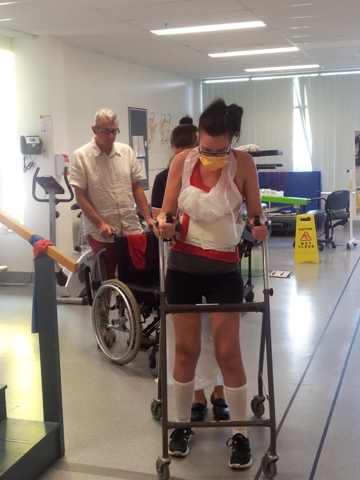
By week six, on Monday, I did my first walk with a tall rollator. Five incredible steps, wobbly and unsure, but steps nonetheless. I couldn't believe it. By Tuesday, I did my first sit to stand without using my arms to push myself up. By the end of the week I walked with my frame from the gym to my room.

I remember this as being one of the toughest yet probably one of the most rewarding moments of my life. That Friday I told my parents to wait in my room at 4pm instead of coming to find me in the gym and wheel me back to my room. My physio's followed me with my wheelchair and they also put a walk belt on me to hold my trunk up ever so slightly. My eyes firmly on the floor, I took each step slowly but surely, sweating with my mask on. As I went down the corridor I dared not look into anyone's eyes, but in my peripheral vision I could see my nurses with ear splitting grins, patients smiling with encouragement and my physio's encouraging me every single step.

I walked into the room to my Dad with his phone filming every moment. I sat down in my chair and we cried and clapped and I felt so, so happy. Drained, exhausted, sweaty, shocked, but proud. I'd did it!

By the beginning of week seven I was holding onto the parallel bars and learning to side step. I could get onto bed without a slide board or push up blocks, but just one giant leap. I was lifting 1kg weights and doing fifty arm to shoulder flexes. I could lift my leg off the bed! I could pull up my own knickers!!!

But I was still neutropenic. I mentioned in a previous blog that I had one more nasty procedure to deal with. It was time to take some bone marrow...